
Total Rewards Strategy That Competes — and Wins
How does your Total Rewards program compare to your competitors?
Is it attracting the right talent for your business?
Are employees leaving because benefits, leave programs, or compensation are no longer meeting their needs?
A strong Total Rewards strategy is one of the most powerful tools an organization has to attract, retain, and motivate talent. Yet too often, programs are built using generic benchmarks or outdated assumptions.
At Locus Human Capital, we believe Total Rewards should never be one-size-fits-all.

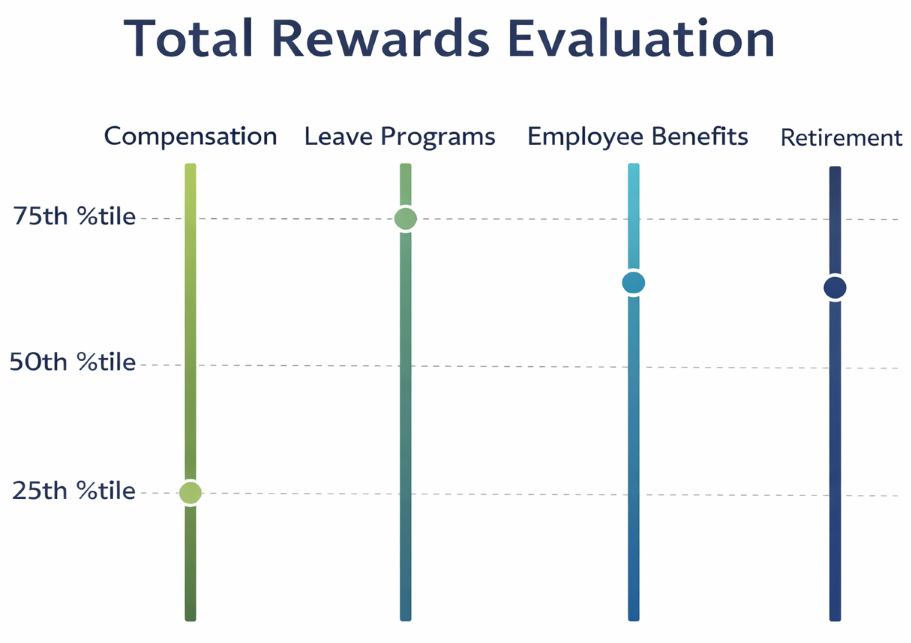
Compensation
Compensation can include base salary, individual and company-based performance bonuses, commissions, stock options and non-qualified deferred compensation plans, such as Supplemental Executive Retirement Plans (SERP) and phantom stock

Employee Benefits
Employee Benefits can include medical, pharmacy, dental, vision, basic life and accidental death and dismemberment (ADD), supplemental life and ADD, critical illness, accident insurance coverages, tuition reimbursement, gym memberships and other perks

Leave Programs
Leave Programs include paid time off, sick time off, named and floating holidays, maternity and paternity leave programs, bereavement, community service and other sabbatical time off programs

Retirement Plans
Retirement Plan includes 401(k), 401(b), fund choice/options, company match, vesting schedules, defined benefit (pension), profit sharing contributions toward retirement plans
A Strategic, Market-Driven Approach
Effective Total Rewards programs are designed around industry dynamics, geographic realities, and competitive positioning — not generic standards.

Industry Specific
A company operating in a highly specialized or technical market may need to lead with compensation while still delivering competitive benefits and long-term incentives. A non-profit organization may face limitations on base compensation, requiring a stronger emphasis on paid time off, flexibility, and tax-advantaged benefits.

Geography Specific
Geography impacts more than compensation structures. The location of your employees can impact regional social programs, mandated sick time minimums, accrued paid time off bank requirements, as well as other leave programs.

Position Specific
You may have the perfect program to attract and retain your accountants, but your engineers are still being lured away by the competition. Position specific analysis – which includes executive-level benefit plans – is often necessary to account for diversity in your workforce.
One Workforce, Many Needs
Total Rewards programs must also reflect the diverse priorities across your workforce:

Entry-level Employees
Often value flexibility in work location and time off. They value tuition reimbursement, professional training, and growth and learning opportunities.

Mid-career Professionals
Often prioritize medical, dental and vision insurance, as well as other family benefit coverages. They are more focused on financial security.

Senior-level Professionals
These professionals are increasingly focused on retirement planning, retirement plan performance and long-term wealth accumulation.